Dark gets the land of light
Stellar Fate and the Radio Window.
Preliminary reminiscence on the early years of applied Nuclear and Radio Physics to the study of distant astronomical objects, followed by a discussion on Supernovae, Neutron Stars & Pulsars.
When the Crab Nebula was observed by the Chinese in 1054 A.D. [1], and, as star-gazing evolved into a science over the next thousand years, no one imagined that the key to understanding all that is “visible” in the sky would lie in the “invisible”. There is an unmistakable awe and philosophy to the story of watching the skies without our sense of vision (i.e. at Radio Wavelengths); and; to the fact that those twinkling fellows keep signalling to us even long after they cease to serve their purpose (i.e. “Twinkle”).
The Fate of Stars
It is common knowledge that stars are huge spheres of gas, mainly hydrogen and helium. Held together by gravity on one hand, they are, also, victims of the “same” gravity, forever trying to collapse them into a smaller volume, and ultimately, causing their death. The forces that “be” make the star go through spectacular phases of a “life” of their own. As they “die”, gravity wins in the end, and some of them of a “certain size” (8 or more Solar Masses) brighten the sky as Supernovae, morphing into neutron stars, with some of these appearing to emit periodic short pulses of radio radiation, and are known as Pulsars.
The rise of spectroscopy as a science to study distant scientific objects during the 19th century was the first cue for astronomers to use stellar emission for their classification. A team of women under Edward Charles Pickering at the Harvard College Observatory, as is famously known, was the first to analyse the spectra of thousands of stars, and classify them accordingly into the OBAFGKMRN system that we use even today. Spectral analysis incited the need for a physical explanation of such categorisation, thus bringing together Astronomy and Nuclear Physics together to ultimately point at the chemical composition of stars as the reason for their beauty. The application of the concept of “Fraunhofer’s Lines” to stellar spectra, paved way to a true understanding of the evolution of stars, in the early 1900's, giving us the much coveted Hertzsprung-Russell diagram [1](Fig.1). This would convince astronomers of an “evolutionary relationship” represented in the diagram.
The application of the concept of “Fraunhofer’s Lines” to stellar spectra, paved way to a true understanding of the evolution of stars, in the early 1900's, giving us the much coveted Hertzsprung-Russell diagram [1](Fig.1). This would convince astronomers of an “evolutionary relationship” represented in the diagram.
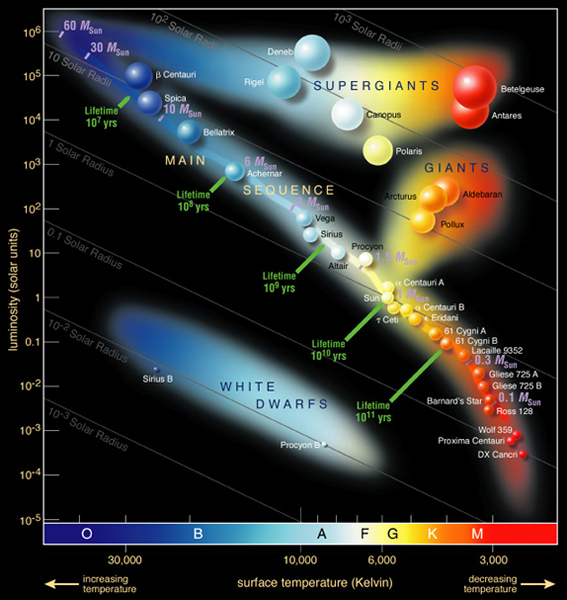
The majority of visible stars are found along the main sequence. As a star ages, its location on the H-R diagram changes, tracing out a path. The path passes through different known stages of stellar evolution, such as the giants and white dwarfs.
Stellar Theory developed further in the 20th century with Arthur Schuster and Karl Schwarzschild demonstrating the balancing of the inward pull of gravity by the outward flow of radiation, in the atmosphere of a sun-like star. Arthur Eddington did one better, by showing that the stars on the H-R diagram represented an evolution from one type to another, in, his classic publication “The Internal Constitution of Stars”. The fusion of atomic physics (quantum-tunnelling) and the general theory of relativity cleared the air about the question of the source of a star’s energy (Not just Gravitational Collapse as a viable source). Atomic energy was the lifeblood of stars… This, developed into the understanding of nucleosynthesis in stellar cores, i.e. how lighter elements turn into heavier ones via fusion in the core, at temperatures as high as 15 million Kelvin.
The heavier elements (Helium for our sun, as an example) sink to the core, with the lighter (Hydrogen) element forming a thick layer above it. The more massive the star, the greater the chance of even heavier elements forming, and, well, of completely different fate in its lifetime as a result. It is in the evolution of these “more massive” stars that the fascinating journey of our discussion lies – For stars as massive as 10 times our sun, and more, there is sufficient pressure and heat for continuous burning to successively produce heavier elements. Like the layers of an onion, the relatively lighter elements continue to form more layers around the core, with the massive star continuing to glow brighter than its lighter cousins, but at a far greater pace, and with a more crushing weight at the core.
The demise of such a star is brought about by the fusion fuelled build-up of iron in the core. The “fusion of iron” requires energy instead of releasing it, which paves the way for the indefatigable Gravity pull to win. As the bulk of the star’s outer layers collapse inward due to gravity, the “core bounce” is majestic enough to forge elements heavier than iron, and the fusion at this collapse releases vast amounts of energy. A spectacular explosion hurling newly formed elements in all directions, and bright as much as a hundred billion stars, outshines even the entire galaxy for a brief time, and is known to us as a “Supernova”. While the outer layers spread out, the core continues to collapse, being crushed under immense gravity to unimaginable densities, giving rise to a new object. A bright glowing object rotating at an enormous speed and so dense that it warps space-time around as it does so – and, begins radiating intense beams of radio waves into space.
This core collapse strips the atoms of the electrons resulting in some sort of a nucleus-electron soup, wherein the core finally reaches a point where it can collapse no further. Subrahmanyan Chandrashekhar (Royal Astronomical Society – January 1935) pointed out (Primarily for White Dwarfs) that beyond a certain minimum size (1.44 times the mass of the sun) even electronic repulsion can be overcome by gravity at the high density of such an event (The Chandra Shekhar Limit). Lev Davidovitch Landau (uncredited), and years later (1934) Fritz Zwicky and Walter Baade proposed one possible outcome (>10 Solar Masses) as an object dense enough to exceed ordinary “nuclear packing fractions”, with a very high gravitational packing energy and consisting mainly of neutrons – to be known as a “Neutron Star”.
Incoming – “Radio”, A Scruff & Little Green Men
The fact that there exists a universe perceptible from beyond our sense of vision was discovered, not by optical astronomers, but by engineers, albeit, by accident (like many great science discoveries), and by those who were not really looking. Karl Guthe Jansky, a radio engineer employed by the Bell Laboratories in the late 1920s was tasked with weeding out a persistent “hiss” at the then considered “short” wavelengths (10-20 meters), to explore ‘Trans-Atlantic” telephony using radio transmissions. The story of Jansky discovering (1931) that the source was an “Extra-Solar” one, is fondly remembered, and told. The dipole antenna he built with a fan beam is awe inspiring, even on a glimpse, and was capable of detecting radio waves @ 14.5 meters, and, amongst other things gained fame as “Jansky’s Merry Go-Round”. – First Radio astronomy detection!
Grote Reber (1934) got interested to take Jansky’s work further, and in 1936 constructed a 31.5 foot fully steerable parabolic dish enabling study of the radio spectrum between 400-150 MHz (0.74-1.99 meters). – First Radio Astronomer (But No Academic Takers, Sadly)! In 1945 although, when Jan Oort’s (Dutch Astronomer) student Hendrik Van de Hulst proposed that the 21-cm wavelength spectral emission from (interstellar) hydrogen be read using a “radio receiver”, Reber was approached, and he even began constructing an antenna. Albeit, he had to abandon the task, for a more lucrative project, and Radio Astronomy had to wait another 6 years when Harold Ewen and Edward Purcell finally “Discovered” the 21-cm line. This was the first-time, astronomers were able to peer beyond the confines of our local stellar neighbourhood.
One of the many achievements in all this was the use of refined radio instrumentation allowing discovery of discrete radio sources, in the sense that such sources were distinguishable from the background. Post the late 1940s, astronomers from Cambridge catalogued several such discrete radio sources (Catalogues 1C-2C), and, while working on their third catalogue (3C), the discovery of the “Quasi-Stellar” object or “Quasar”[2] 3C273, discovered as a radio source roughly 2 billion light years away, was an ultimate cry for attention towards the universe at radio wavelengths.
Finding Quasars had become a task of interest by the late 1960s, and paved way for immense repute for a PhD. student, Jocelyn Bell, under the supervision of Anthony Hewish. Hewish was a pioneer of Radio Interferometry at Cambridge, and had developed the Interplanetary Scintillation Array (IPA) [3], to collect radio signals from space, and record them on paper. Amongst one of the many recordings, began to appear a “Scruff” on the paper (non-artificial), appearing for the first time in August 1967, and traced out diligently over the next few months, by Hewish and his team. In November 1967, “fast recorded” pulses, helped discover a radio source flicking on and off with a period of 1.3 seconds. This was CP1919, a pulsar, whose discovery opened an entirely new field of astronomy. Jocelyn Bell jokingly referred to these signals as “Little Green Men”, symbolic of possible signals from aliens. This, off-course, was before a few more months of deliberation and analysis, when in 1968, these Pulsating Radio Sources, or “Pulsars” became widely known.
Supernovae
Supernovae are immense stellar explosions resulting from either a disruption or collapse of a star, to a compact object. The event is characterised by a luminosity surge to at least 100 million times than that of our sun, and the show of energy outburst can be seen for many weeks, in the sky, with only a very gradual decline. Not all supernovae are objects of interest for Radio detection, but it makes academic sense to discuss them broadly. Stars more massive than 8 solar masses are candidates for a core collapse supernova.
An evolutionary scheme for massive stars was suggested by Peter Conti in 1976, and then with some modification, a general evolutionary path can be studied. This is a qualitative evolutionary scheme well supported by numerical evolution models of massive star formation. Mass loss typical of massive stars, and modelling with and without rotation can be used to plot these tracks. When considering rotation, an equatorial rotation speed of 300 km/s is considered. These are attributed to Georges Meynet and Andres Maeder, and help point out that rotation can have an appreciable effect on stellar evolution. The idea of including this scheme here is to build upon the process of a supernova, and, then, talk about the various classes of supernova, of which, some are of interest at radio wavelengths.
Such evolutionary tracks tell us that the most massive stars never evolve, to a stage known (not discussed here) as the Red super-giant, as is also indicated in the upper right-hand corner of the H-R diagram. It was pointed by Roberta M. Humphreys and Kris Davidson (1979, ApJ 232, 409) that there is an upper luminosity cut-off in the H-R Diagram consisting of two sections, - the sloping, and the horizontal part. The sloping part decreases with decreasing effective temperature (Teff), and corresponds roughly to the “Eddington Limit”[3], and the horizontal part is the temperature independent upper luminosity limit for hyper-giants. It is understood massive stars above the Humphrey-Davidson limit experience high mass loss episodes, preventing their evolution to cooler temperatures. Although very massive stars are not too many, (1 in a million stars is the category of 100 solar masses, i.e. a Very Massive Stars).
Core Collapse Supernovae
All Supernovae other than type 1a undergo core-collapse explosions. The goal of understanding the physical processes involved in generating supernovae, is to understand in what 'forms', the energy is subsequently released. While we are yet to discuss the types, a typical type 2 supernova releases about 1046 J of energy, with about 1% of it as K.E., and < 0.01% as photons to give us the pleasure of a spectacular visual in the sky. The remainder is radiated in the form of neutrinos. This is also the case with Type 1b and type 1c supernovae. Collectively, Type 1b, 1c, and type 2 are known as core-collapse supernovae.
As the core of an ageing and massive star gets hotter, contracting to successive stages of thermonuclear fusion, and we know from the basics of Wien’s law and Planck’s law the energy of emitted photons should go up. A core that is still burning helium, it continues to add ash to the carbon-oxygen core, and contracts to ignite carbon burning. This goes on to promote silicon burning, the core temperature reaches a few a hundred million kelvins, photons energetic enough facilitate the creation of neutrinos. These neutrinos carry off energy and escape the stars’ core. Silicon burning facilitates production of a host of nuclei near the binding energy of iron isotopes, and any further reactions are endothermic, ceasing to contribute to the luminosity of the star.
As higher temperatures are attained, photons possess enough energy to destroy heavy nuclei, a process known as photo-disintegration. The process evolves to strip down iron nuclei to individual protons and neutrons, and is highly endothermic. Extreme conditions now exist to allow capture of free electrons by heavy nuclei and protons. The energy that escapes during this via neutrinos is enormous. The free electrons are now unavailable to assist via electron degeneracy pressure, and the core now begins to collapse rapidly, with the velocity of the collapse being proportional to the distance away from the centre. During the collapse, speeds can reach to almost 70,000 km/s in the outer core, and, one can imagine the volume of the size of earth being compressed down to a radius of 50 km, in a matter of 1 second.
This collapse continues to densities exceeding 8 * 1017 Kg/m^3, post which, the strong attractive force in the core suddenly becomes repulsive as a consequence of the Pauli exclusion principle applied to neutrons. There is an inner core rebound, sending pressure waves outward onto the in-falling material from the outer core, or the envelope. Pressure waves reaching the speed of sound act as shock waves to create higher temperatures for further photo-disintegration, and, below the shock, a neutrino-sphere develops from the processes of photo-disintegration and electron capture. The star’s envelope is successively ejected. These events, are understood to be the general process of a core collapse, and the classification into type 2 instead of 1b or 1c is thought to have to do with the composition and the mass of the envelope at the time of the core collapse, and the amount of radioactive material synthesised in the ejecta.
Classification of Supernovae – A Spectral View
Supernovae light curves and spectra have been carefully studied for years now, and several classes of underlying progenitors and mechanisms can be identified.
Type 1a: The spectrum of such events is devoid of any hydrogen or helium lines, but does have a strong absorption line of ionised silicon. They are produced by runaway carbon fusion in a white dwarf in a close binary system. It is known that the ionised silicon is a by-product of carbon atoms.
Type 1b: No hydrogen lines in the spectrum, but strong absorption lines of unionized helium (He I). The result of a core collapse in a massive star that lost the hydrogen from its outer layers.
Type 1c: No Hydrogen or Helium lines in the spectrum, and produced by the core collapse in a massive star that lost both hydrogen and helium from its outer layers.
Type 2: The spectrum has prominent hydrogen lines such as Hα, and facilitated by core collapse in a massive star whose outer layers were largely intact.
From an observational perspective, Type 2 Supernovae are characterised by a sharp rise in luminosity, with maximum brightness typically 1.5 magnitude dimmer than 1a. The light curves of type 2 supernovae can be classified as either type 2-P(Plateau) or type 2L(Linear). Composite B magnitude light curves plotted against the number of days after maximum light, illustrate this better. A comparison with type 1 supernovae light curve also helps the context.
Neutron Stars
Neutron stars are morphed at a stage when the “degenerate” core of the ageing super-giant star that has undergone a supernova explosion, nears the Chandra Shekhar Limit. For instance, a 1.4 solar mass neutron star would consist of 1057 neutrons in a volume of roughly no more than 10-15 km, and is held together by gravity, supported by neutron degeneracy pressure. The density of a neutron star is averaged to be about 6.65 * 1017 kg/m^3, and the pull of gravity is 190 billion times stronger than the acceleration of gravity on earth.
The neutron star, at a certain stage, (Density @ roughly 1014 kg/m^3) is known to be characterised by the “Neutron-Drip”, which is a minimum energy arrangement of a neutrons outside the nuclei, and marks the start of a three-component mixture of a lattice of neutron-rich nuclei, non-relativistic degenerate free neutrons, and relativistic degenerate electrons. This is a fluid of “No Viscosity”, and happens to exist because a spontaneous pairing of the degenerate neutrons has taken place. It is a intriguing combination of two fermions to form a boson, and hence free of the restrictions of the “Pauli-Exclusion” Principle. It is understood that degenerate bosons can all crowd into the lowest energy state, hence meaning that the fluid of paired neutrons can lose no energy. It is a “Super-fluid” in which any whirlpools or vortices will continue to spin forever, meaning, a “flow” without any resistance.
At further contraction (density @ 1015 Kg/m^3), the neutron degeneracy pressure exceeds the electron degeneracy pressure, and subsequent contraction results in a fluid mixture of free neutrons, protons, and electrons, and the neutrons and the protons paired to form super fluids. The fluid of this pair is also superconducting. While the properties of neutron star are an intense and intriguing area of study, it is their magnetisation and the pulses of radiation they can emit, which is of interest to this discussion.
Pulsars
Pulsars, can be defined as magnetised neutron stars that appear to emit periodic short pulses of radio radiation, there periods being between 1.4 mili seconds to 8.5 seconds. A rotating, magnetised neutron star is like a lighthouse beacon. As it rotates, the beams of radiation sweep across the sky. If at some point during the rotation, a beam is pointing toward the earth, we detect a flash/signal as there is a “sweep”. A radio telescope detects regular pulses of radiation, meaning, “one pulse” being received for each rotation of the star. The radio emission mechanism of pulsars is not well understood, but we do know that the pulse periods are quite stable. Fractional errors as small as 10-16 can be timed with them, and they, are the ultimate clocks of the cosmos.
Pulsar Timing and Pulsar Timing Arrays for Gravitational Wave Detection
Pulsar Pulses when observed by a radio telescope, immediately reveals that individual pulses are different from each other. However, the average number of pulses is very stable. Pulsar timing arrays (PTAs) are projects that make use of radio waves observations of pulsars. The PTAs’ sensitivity to gravitational waves caused by supermassive black hole binary systems. It involves two different important processes.
Firstly, the phase when mutually orbiting black holes approach each other because of the gravitational waves they emit. There comes a point when their period shrinks to just a few years, and the gravitational waves they emit is considered optimum for detection by a PTA. Secondly, a phenomenon known as the wave memory effect produced by two “merging” supermassive black holes, wherein, as the merger happens, space-time does not restore to the exact same state it was before the violence of gravitational waves warped it strongly. It will be slightly stretched in one direction and compressed in the other. This is a permanent effect that can be detected by PTAs.
Summary
Observational astronomy has moved from mere optics to a vast variety of detection techniques, outside the visible spectrum, that is to say, Radio Wavelengths, and as an extension, gravitational waves, all using the concept of radio emissions from distant and magnificent celestial objects spread across the cosmos. We have also, interestingly, seen the fusion of different branches of physics into astronomy, to look at the larger picture. Peculiarly awe inspiring is the realisation that the most majestic of events in the universe boil down to physics at the minutest of scales.
The concepts of Dark Matter (evidence) , and the Cosmic Microwave Background detection via radio astronomy at all deserve a separate mention, which is only proof to the fact that we have our hands full with literally everything we would wished to work upon, and study – All this enabled by a part of the spectrum that we can barely feel via our five senses. The understanding of Stellar evolution as has been enabled by the understanding of Supernovae and Neutron Stars, would not have been possible, had we not detected the “Radio” scruff, or, for that matter , would not have been worried about a certain static “hiss” bothering our communication frequencies at the radio wavelengths.
The Universe at Radio wavelengths is so clearly (Completely) visible, that nothing seems out of our bounds to detect now. With the fascinating discovery of gravitational waves, and the use of PTA's to detect such phenomenon as Black hole mergers, it is not too much to say that our quest has been honoured by the “Forces that be”.
[1] Due to independent works by Henry Norris Russell, and Ejnar Hertzsprung who could show that different line widths in stellar spectra were directly related to spectral brightness.
[2] A quasar (/ˈkweɪzɑːr/) (also quasi-stellar object or QSO) is an active galactic nucleus of very high luminosity. A quasar consists of a supermassive black hole surrounded by an orbiting accretion disk of gas.
[3] Maximum Luminosity a star can achieve when there is a balance the force of radiation acting outward and the gravitational force acting inward.